


Choosing a Salesforce Partner? Ask Its Past Clients What Lasted
Exploring this for your team? Talk to CrmWare →
What a Salesforce partner award actually rewards
If you are shortlisting a Salesforce implementation partner, some proposals in front of you may now carry a new badge. Salesforce published its 2027 Partner of the Year results on 27 August 2026,[1] and winners receive a digital badge for their web properties.[2]
Salesforce says winners were evaluated by an international panel of Salesforce leaders, using a mix of quantitative results and qualitative judgment, with emphasis on customer success, innovation, adoption and measurable business value. Winning submissions needed before-and-after narratives with measurable customer outcomes and authentic customer voices.[1]
The call for entries says any partner could enter and partners prepared the submissions. The only customer involvement it describes is the partner attesting that the customer authorised use of its information. The awards are aligned, Salesforce says, with its FY27 priorities.[2] The pages we reviewed do not describe customer-side verification of submitted outcomes.
In our reading, the criteria point to good questions and the award is weak evidence about fit for your organisation. It tells you what a Salesforce panel valued in a submission the partner prepared, against Salesforce's priorities. It does not tell you whether that account was checked with the client, whether the result lasted, or whether it would hold in an organisation like yours. That is a limit of the evidence, not a verdict on the winners.
What the partner programme's outcome measures still leave out
The strongest objection comes from the partner programme, which is separate from the awards. In a March 2026 announcement, Salesforce says recognition in the programme "is tied strictly to project outcomes, CSAT, and certifications", and anchors success in "verifiable customer outcomes".[3]
The announcement names its measures (CSAT scores, specialisations and certifications) but does not say how outcomes are verified.[3] Salesforce's FY27 consulting partner brochure lists what each Competency is measured by: certifications, completed projects and customer satisfaction (CSAT).[4] CSAT is a rating given by the partner's customers, not a partner self-assessment.
This is real progress, but none of these measures shows a result against a baseline, use that lasted after go-live, or who at the client runs the solution today.
So keep programme standing as a shortlist filter, and take the question of fit to the partner's past clients.
Four questions to ask a partner's past clients
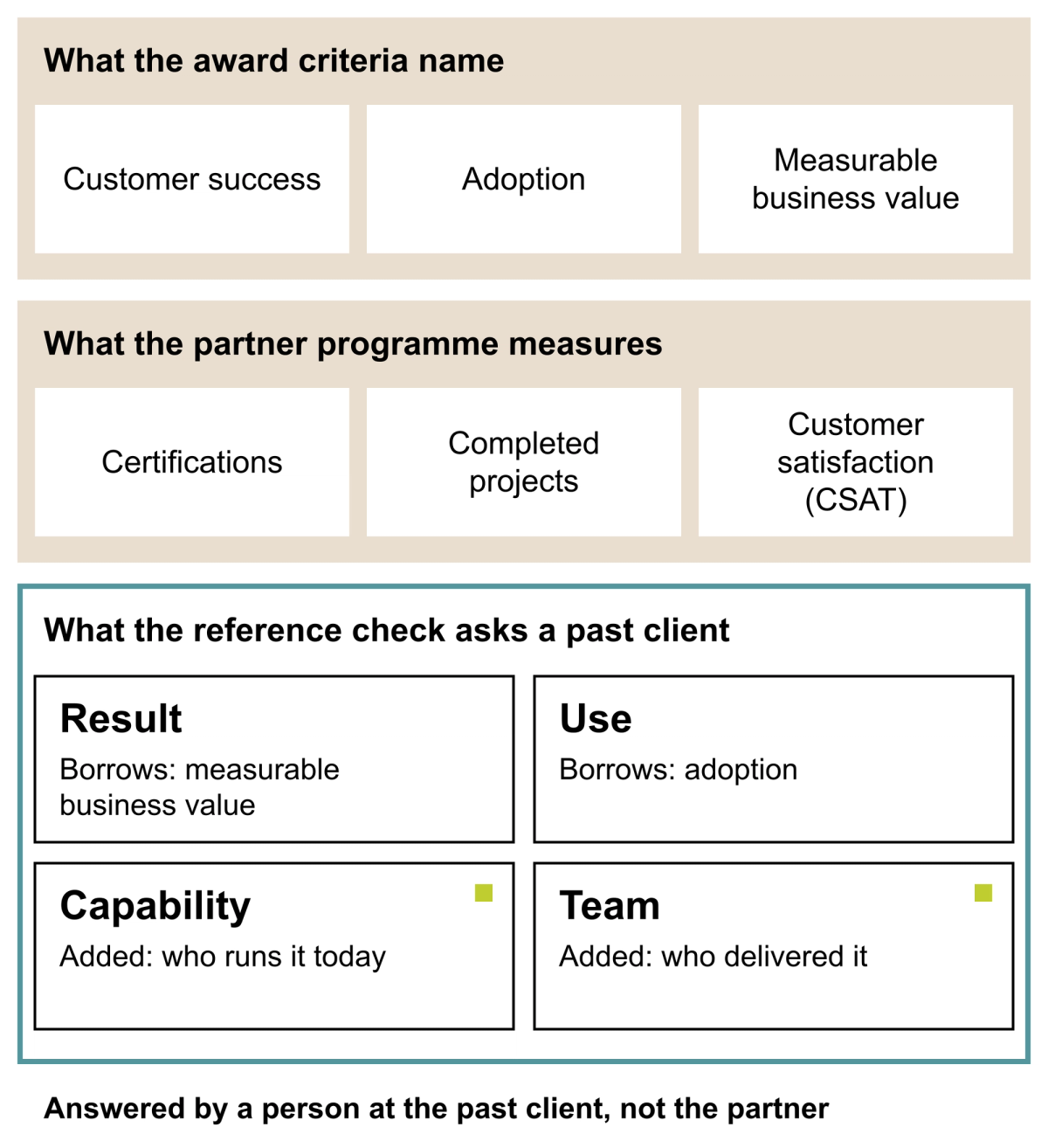
The reference check borrows two of the award criteria and adds two questions that neither the award criteria nor the programme's measures cover. The first three ask what the programme's measures leave out.
- Result. What changed, against what baseline, and who at the client measured it. This is Salesforce's criterion of measurable business value,[1] asked where it can be checked. What Did Go-Live Actually Prove? explains baselines and observation periods.
- Use. Whether the intended people still use the solution as designed, at a date after go-live the client can name. Salesforce's awards page itself separates deployment from adoption: an agent switched on is not one that changes how a business runs.[1] A 2005 research review points the same way, suggesting that most users apply a narrow band of features and rarely extend them.[5]
- Capability. Who at the client runs and changes the solution today, and who made the last significant change. Clients expect consultants to leave them able to maintain systems independently, and a study of 96 ERP implementations found that how much knowledge transferred depended on several factors.[6] Reviewing the UK government's use of consultants, the National Audit Office puts it plainly: civil servants need to learn enough to keep an initiative going after the consultants' contracts end. Most respondents to its survey also said consultants made a valuable contribution,[7] so a partner still involved is not a failed answer. What matters is that someone at the client can name who runs it and who changed it last: capability that stays inside the organisation.
- Team. Which people who delivered that work are in the team proposed to you. The UK Cabinet Office's 2022 Consultancy Playbook tells evaluators to satisfy themselves that the team proposed in a bid is the team that will work on the engagement.[8] We extend that to the past project: a track record counts only if the people who built it are the people you will get.
An answer counts when a person at the past client, not the partner, can give it with a number, a date or a name. An answer only the partner can give is a claim to check, not evidence.
Run the reference check on every shortlisted partner, including us
Often the partner decides which past clients you hear from. A study of purchasing managers starts from that problem: suppliers, not buyers, select the reference customers, so buyers may see the referral as biased.[9]
So ask each partner for its comparable projects and choose which past clients to speak to. Define comparable yourself; a useful start is similar scope, recent enough that the people who delivered it may still be with the partner.
Then weigh the answers. US federal procurement treats past performance as one indicator of ability to perform, and considers the currency, relevance and source of the information.[10] Applied to a private shortlist, recent and similar answers confirmed by the client count for more than older, dissimilar ones that only the partner can give. Good answers improve your evidence. They do not prove the partner will get the same result with you.
CrmWare is a Salesforce consultancy that would itself appear on shortlists like yours, and an argument for looking past badges can suit a firm that competes with badge holders. So the reference check applies to us as much as to anyone.
Once a proposal becomes a deal, and especially if it includes AI agents, The Ownership Test scores what you would control under its terms.
References
[1] Salesforce. Announcing the 2027 Salesforce Partner of the Year Award Winners. 2026. https://www.salesforce.com/blog/announcing-the-2027-salesforce-partner-of-the-year-award-winners/
[2] Salesforce. Celebrating Innovation: The 2027 Salesforce Partner Awards. 2026. https://www.salesforce.com/blog/salesforce-partner-awards-2027/
[3] Salesforce. The Outcome Advantage: Driving Customer Value through the New Salesforce Partner Program. 2026. https://www.salesforce.com/news/stories/rewarding-value-through-new-salesforce-partner-program/
[4] Salesforce. FY27 Salesforce Consulting Partner Program: Built to Lead in the Agentic Era. 2026. https://www.salesforce.com/en-us/wp-content/uploads/sites/4/documents/partners/readiness/fy27-consulting-partner-program-brochure.pdf
[5] MIS Quarterly (Jasperson, Carter and Zmud). A Comprehensive Conceptualization of Post-Adoptive Behaviors Associated with Information Technology Enabled Work Systems. 2005. https://aisel.aisnet.org/misq/vol29/iss3/8/
[6] MIS Quarterly (Ko, Kirsch and King). Antecedents of Knowledge Transfer from Consultants to Clients in Enterprise System Implementations. 2005. https://aisel.aisnet.org/misq/vol29/iss1/5/
[7] UK National Audit Office. Lessons learned: the government’s use of external consultants. 2025. https://www.nao.org.uk/wp-content/uploads/2025/11/governments-use-of-external-consultants.pdf
[8] UK Cabinet Office. The Consultancy Playbook, Version 1.1. 2022. https://assets.publishing.service.gov.uk/government/uploads/system/uploads/attachment_data/file/1103954/The_Consultancy_Playbook_Version_1.1_September_2022.pdf
[9] Journal of Supply Chain Management (Hada, Grewal and Lilien). Purchasing Managers' Perceived Bias in Supplier-Selected Referrals. 2013. https://doi.org/10.1111/jscm.12007
[10] US FAR Council (Federal Acquisition Regulation), Acquisition.gov. FAR 15.305 Proposal evaluation. 2026. https://www.acquisition.gov/far/15.305