


How to Choose an Agent-Design Method for Governed AI Workflows
Exploring this for your team? Talk to CrmWare →
The engineering decision begins after the workflow is governed
Begin with an approved governed workflow: an objective-led operating brief with a known bottleneck, baseline and target outcome. It must also fix the permitted actions, human decision points, exception path and accountable owner.
Now test the handoff with one revealing failure. The agent submits an external action, but confirmation is lost. Creating an order, transferring money and sending a message do not have the same retry semantics. Before anything retries, the architecture must say how the system verifies the external state, prevents duplicate effects, compensates, recovers or requests a human decision.
A useful agent-design method must turn the brief into explicit decisions about execution state, transitions, tool authority, recovery, human control and evaluation. AWS frames these as bounded behaviour, traceability, proportionate human oversight and explicit contracts.[1] Microsoft starts that design before a builder is opened.[2] CEAD treats capability, boundary, autonomy, interaction, state and evaluation as primary design objects.[3]
First choose the kind of instrument
- A primary design method accepts the governed-workflow brief and organises production or review of the resulting architecture. It may take the form of a canvas, architecture lens, capability contract or platform decision framework.
- A complementary guide helps with part of the work. Google Cloud supplies a pattern catalogue; OpenAI and Anthropic provide component and orchestration guidance.
- A technical specification, such as Auton, defines a blueprint and runtime architecture.
- A transformation system, such as COMPEL, covers organisational strategy, governance and delivery.
The last three can supplement a design method, but they do not occupy the same decision role. Excluding them from the matrix is a category decision, not a judgement of quality.
What to look for in an agent-design method
To choose a method, assess what it helps the team decide and produce, and whether the team can use it in practice.[4] CrmWare adds an ownership question: can the organisation retain and adapt the method without its original provider?
- Intended-use fit: Does the method fit this task and context?
- Method definition: Are its concepts, procedure, representations, tools and expected outputs clear?
- Decision guidance: Does it help practitioners make and justify choices?
- Design-output coverage: Does it cover execution, state and transitions; tools and permissions; safe repetition, compensation and recovery; human control; evaluation and observability?
- Practical applicability: Can a multidisciplinary team understand, learn and follow it?
- Independent use: Can the organisation retain, adapt and reuse the method and its artefacts without the original provider?
Independent use makes CrmWare's capability-ownership position explicit. It is not a proxy for vendor neutrality or architecture portability. A vendor-issued method can remain independently usable, while a reusable method can still produce a platform-coupled architecture.
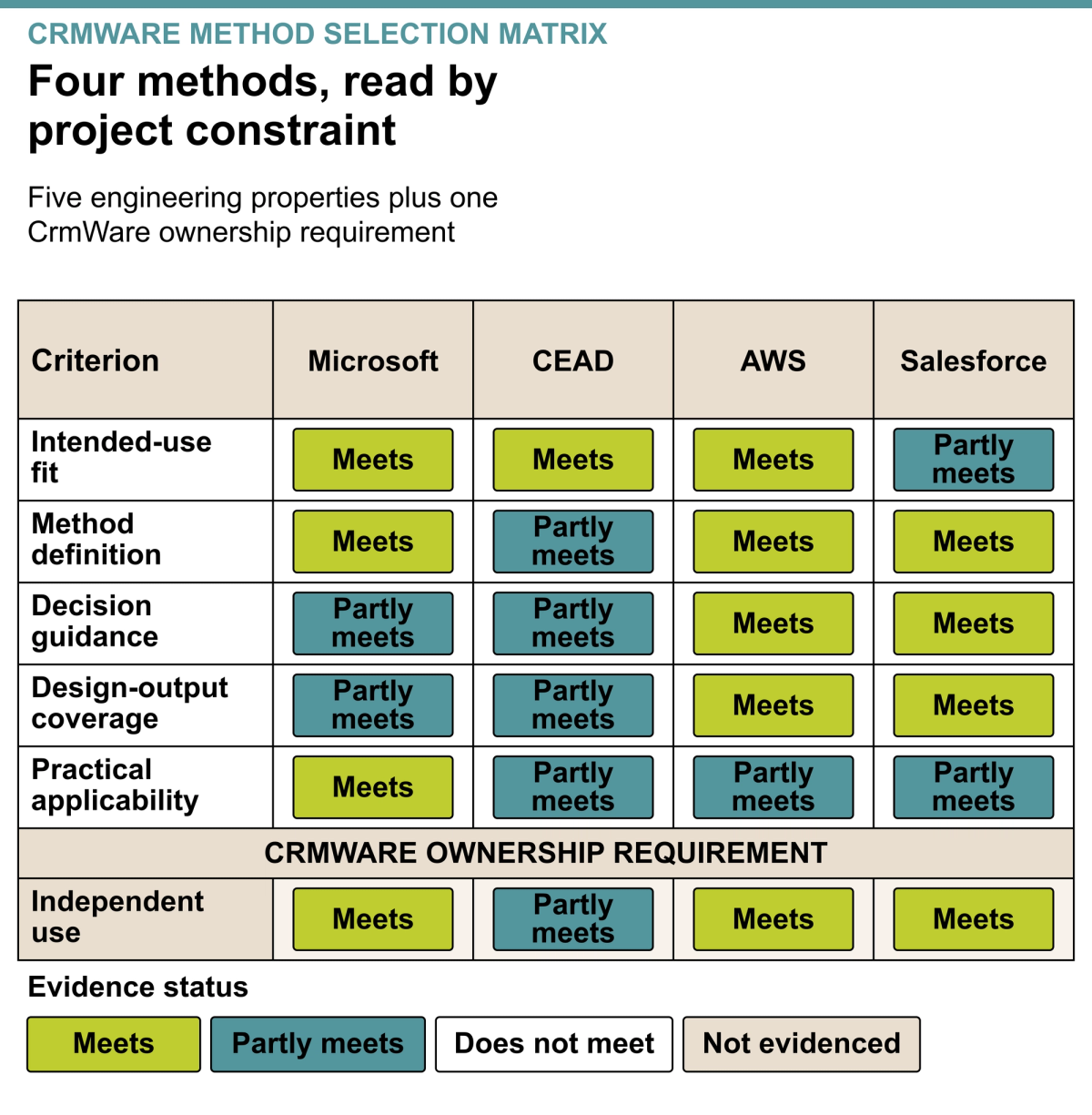
The matrix records meets, partly meets, does not meet or not evidenced. There is no total: each status points to a strength, a question to validate or a gap to mitigate.
Four agent-design methods applied to the same brief
The matrix normalises the evidence; the profiles explain decision-relevant distinctions.
Microsoft Agent Design Framework
- Intended-use fit (meets): Built for pre-build agent design.
- Method definition (meets): Canvas, prompts and a worked example.
- Decision guidance (partly meets): Questions outweigh explicit trade-offs.
- Design-output coverage (partly meets): Broad coverage with lighter recovery detail.
- Practical applicability (meets): Editable canvas and worked example.
- Independent use (meets): Public canvas and reusable worksheet.
Microsoft becomes relevant when a team needs a shared design artefact quickly. Its canvas gives goals, triggers, tools, data, orchestration, governance and evaluation an explicit place. The method also addresses irreversible actions, approvals, escalation, tests and telemetry.[5] A worked example shows how the fields fit together.[6] High-risk workflows may still need complementary recovery guidance.
CEAD
- Intended-use fit (meets): Built for enterprise agent capability design.
- Method definition (partly meets): The contract is specified, but the procedure is less explicit.
- Decision guidance (partly meets): Strong constructs with a limited practical sequence.
- Design-output coverage (partly meets): Strong contracts and controls, but a less explicit recovery procedure.
- Practical applicability (partly meets): Dense preprint with no public template.
- Independent use (partly meets): Public specification without a reusable template.
CEAD becomes relevant when explicit capability boundaries are the decisive constraint. Its Agent Capability Contract specifies purpose, ownership, autonomy, schemas, tool scope, memory, verification, human interaction, evidence and observability.[3] For a lost confirmation, that contract can expose who may decide and which evidence the decision requires. The team must still turn a dense preprint into a working sequence and reusable template.
AWS Agentic AI Lens
- Intended-use fit (meets): Built to design and review agentic systems.
- Method definition (meets): Pillars, questions, practices and code.
- Decision guidance (meets): Guiding questions and implementation advice.
- Design-output coverage (meets): Contracts, recovery, oversight and observability.
- Practical applicability (partly meets): Comprehensive but extensive.
- Independent use (meets): Public lens and reusable review questions.
AWS suits teams whose operational risk justifies a deeper lifecycle review. Its six-pillar lens combines guiding questions, practices, implementation guidance and code.[7] Explicit contracts, bounded scope, traceability, versioned behaviour and human oversight connect retry and recovery to ongoing operation.[1] The trade-off is scope: the team must decide how much of that depth belongs in the first architecture pass.
Salesforce Well-Architected
- Intended-use fit (partly meets): Fits Salesforce-centred architecture.
- Method definition (meets): Framework, lenses and practices.
- Decision guidance (meets): Concrete architecture and reliability advice.
- Design-output coverage (meets): Permissions, retries, recovery, handoff and tracing.
- Practical applicability (partly meets): Guidance spans several documents.
- Independent use (meets): Public framework and reusable review method.
Salesforce becomes relevant when the platform choices are already architectural commitments. Its Well-Architected Framework is designed for Salesforce solutions.[8] Salesforce says hundreds of architects contributed to its development; that establishes participation, not better project outcomes.[9] The agentic guidance addresses deterministic execution, permission boundaries, human oversight and tracing.[10] Its reliability guidance adds fallbacks, checkpoints, durable retries, handoff and failure testing.[11] Native controls may reduce translation work, in exchange for a platform dependency the team should accept consciously.
Choose by constraint, not by total
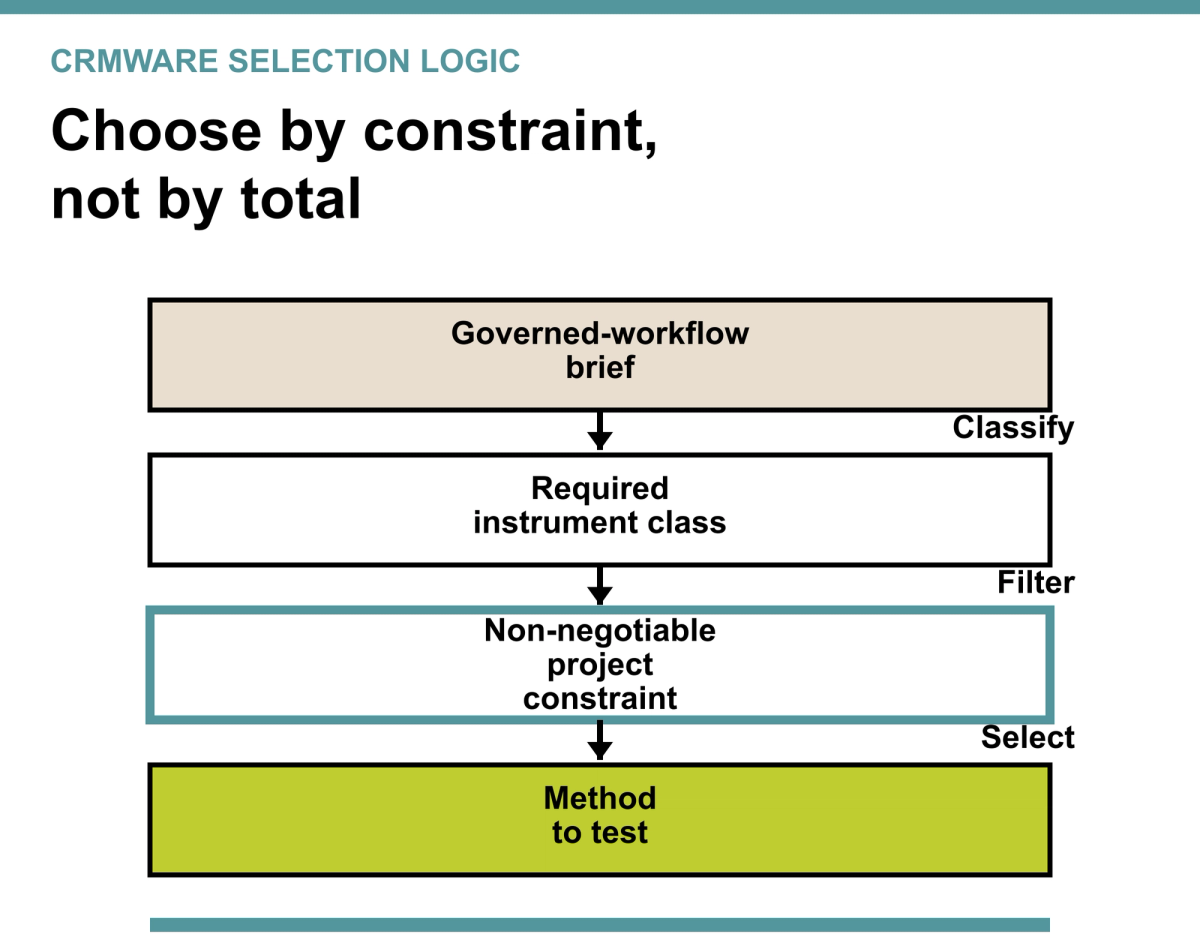
Use the matrix as a decision procedure:
- Identify the project's non-negotiable constraints.
- Inspect the relevant criterion or design-output subdimension.
- Remove a candidate only when it does not meet a constraint. Treat not evidenced as a question to validate and partly meets as a gap to mitigate.
- Compare the remaining trade-offs, select one method to test and record which complementary instruments are still required.
If the non-negotiable is a shared artefact the team can use immediately, test Microsoft. If explicit capability boundaries are decisive, test CEAD. If operational risk requires deeper recovery, observability and lifecycle review, test AWS. If Agentforce, Flow, Salesforce permissions, data services and native observability are already architectural commitments, test Salesforce and decide whether the saved translation work justifies the resulting dependency.
Selecting a method does not establish what the client will own after implementation. Apply a separate portability test to the resulting architecture.
There is no universal winner. Choose the method whose relevant strengths satisfy the brief, then preserve the reasoning and make every accepted dependency visible. That is the practical meaning of owning a digital workforce.
References
[1] Amazon Web Services. Design principles - Agentic AI Lens. 2026. https://docs.aws.amazon.com/wellarchitected/latest/agentic-ai-lens/design-principles.html
[2] Microsoft. Design effective agents using a structured design framework. 2026. https://learn.microsoft.com/en-us/microsoft-copilot-studio/guidance/agent-design-canvas-overview
[3] John deVadoss, InterWork Alliance. Designing Intelligent Enterprise Agents: A Capability-Aligned Multi-Agent Architecture. 2026. https://arxiv.org/abs/2605.08258
[4] Cambridge University Press, Design Science. Elements of a design method - a basis for describing and evaluating design methods. 2022. https://www.cambridge.org/core/journals/design-science/article/elements-of-a-design-method-a-basis-for-describing-and-evaluating-design-methods/A7387B643DBFDB5DF9075261D7D61408
[5] Microsoft. Use the agent design framework. 2026. https://learn.microsoft.com/en-us/microsoft-copilot-studio/guidance/agent-design-canvas-framework
[6] Microsoft. Apply the structured design framework to an autonomous email support agent. 2026. https://learn.microsoft.com/en-us/microsoft-copilot-studio/guidance/agent-design-canvas-example
[7] Amazon Web Services. Agentic AI Lens - AWS Well-Architected. 2026. https://docs.aws.amazon.com/wellarchitected/latest/agentic-ai-lens/agentic-ai-lens.html
[8] Salesforce. Well-Architected Framework. 2026. https://architect.salesforce.com/docs/architect/well-architected/guide/framework.html
[9] Salesforce. Introducing the New Salesforce Well-Architected Framework. 2026. https://www.salesforce.com/blog/new-well-architected-framework/
[10] Salesforce. The Agentic Enterprise. 2026. https://architect.salesforce.com/docs/architect/well-architected/guide/agentic-enterprise.html
[11] Salesforce. Reliability for the Agentic Enterprise. 2026. https://architect.salesforce.com/docs/architect/well-architected/guide/agentic-enterprise-reliability.html