


If the Work Happens in Claude, What Is Salesforce For?

Exploring this for your team? Talk to CrmWare →
Salesforce wants a role even when the work happens elsewhere
Suppose a seller asks Claude what moved in the pipeline this week, then asks it to update three opportunities. The seller makes both requests in Claude, while Salesforce holds the records and processes the updates.
If the work happens in Claude, Salesforce can still provide the business data, permissions, rules and processes that the work depends on.[1][2] Using Claude as the interface does not, by itself, replace those capabilities.
Our reading is that Salesforce is positioning these capabilities for use beyond its own interface. Its proposed Trusted Enterprise AI Harness brings together capabilities it says customers can combine with Salesforce technology, their existing technology, or both.[3] That could extend its role into workflows where employees rarely open Salesforce.
For existing customers, the commercial question is what they can reuse from their investment and what they would need to buy or integrate. For companies without Salesforce, the offer has to justify introducing another platform alongside the systems they already run.
Both questions are easier to answer once you know what already sits around a model when it does work.
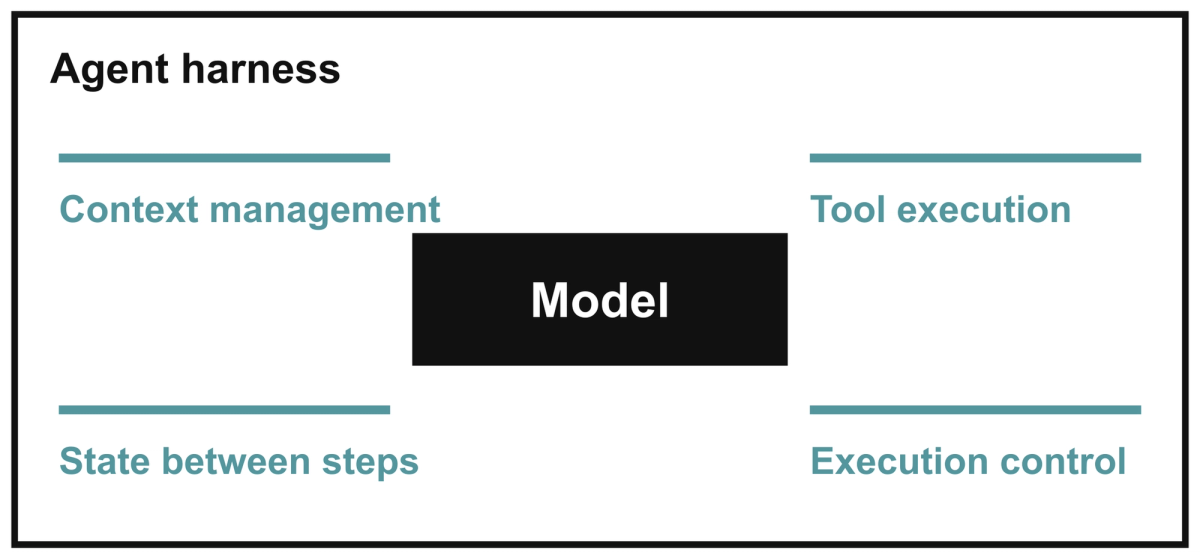
Claude already has software around the model
An agent is a model plus the software that runs around it, deciding what the model sees, which tools it may call, what is kept between steps, and where it has to stop. That software is called a harness.[4] Definitions vary: Anthropic names four parts, and a June 2026 survey preprint names six.[5]
The division is visible in the Claude API. The model returns a structured request to call a tool, and the application executes it and returns the result; some tools run on Anthropic's own infrastructure instead.[6]
Anthropic also sells this layer as a product. In Managed Agents it runs the harness, holds context outside the model's context window, and executes tools in a sandbox.[7]
How well the layer is built decides how much use you get out of a capable model. In evaluation work, weak scaffolding or weak tools are a known cause of failures that say nothing about the model, and of very large differences in measured performance.[8]
Salesforce is therefore proposing capabilities alongside an existing agent environment. Where they complement each other, or overlap, depends on how the implementation assigns responsibilities.
What Salesforce proposes to add
Salesforce introduced the Trusted Enterprise AI Harness on 10 September 2026: six capabilities, plus a separate AI Control Plane it describes as a common place to see, manage and control agents and AI across the enterprise.[3] In its own labels the six are Context, Agency, Action, Governance, Security and Models. Between them they cover business context drawn from company data, permissions and business rules applied on the path an action takes, and connection to applications, APIs and business processes.[3][1]
The proposal is to offer these as shared company capabilities rather than something each team assembles per agent, reachable from several interfaces including Claude, Slack, Microsoft Teams and Agentforce, through connection points such as MCP, APIs and Plug-ins.[3]
Salesforce says it is drawing on core technologies from across Data 360, Informatica, MuleSoft and Agent Fabric, Tableau, Agentforce, Salesforce Guardian and the Salesforce Platform.[3] For a buyer, the practical question is which of these products and capabilities a particular use case requires.
The flexibility above is a statement of intent. Whether the pieces separate cleanly in an implementation is not established by the announcement, and the commercial terms are deferred until closer to general availability.[3]
What Claudeforce connects
The commercial partnership between Salesforce and Anthropic was expanded on 14 October 2025.[9] Claudeforce was announced on 26 August 2026, and Salesforce in Claude is a plugin inside it carrying 37 ready-made sales skills.[1] The Trusted Enterprise AI Harness followed on 10 September 2026.[3]
As announced, Claudeforce runs in two directions. Claude works inside Agentforce as a reasoning model for the Atlas Reasoning Engine, which plans what an agent does. Salesforce works inside Claude through the plugin, so a seller can read live revenue data, update pipeline and act there.[1]
Availability differs across three subjects.
- Platform components. On 15 April 2026 Salesforce described AI Gateway, MCP Bridge and Trusted Agent Identity, which lets agents "execute actions using specific user permissions", as generally available.[2]
- The plugin. The 26 August 2026 announcement states it was open to selected pilot customers, with an open beta expected in September 2026.[1]
- The unified Harness experience. Many underlying technologies are said to be available today, without saying which, and new capabilities are planned to start rolling out in early fiscal FY28.[3]
"Generally available" means the vendor says a feature is released for general use; Salesforce adds that availability varies by region and is governed by customer agreements.[1] Salesforce attaches no availability date to any of the six capabilities individually. One independent analyst puts the AI Control Plane about a year away, as his reading rather than a Salesforce commitment.[10]

What we would assess before committing
None of this settles whether the two sides complement each other or overlap. That is decided in a real deployment, by who is configured to do what.
If you already use Salesforce, start with a business process that is worth improving, not with the capability list, and work out which data, permissions and processes an agent could reuse. Confirm which controls apply to each action: Salesforce says actions routed through it help ensure business rules are enforced, and that agents can execute actions using specific user permissions.[1][2] What covers the systems Salesforce does not run is not established in the sources we reviewed. Then establish what requires an upgrade and what it adds to the cost. Salesforce says existing technologies provide the foundation and that customers "will be able to upgrade eligible Salesforce investments", without defining eligible.[3]
If you do not use Salesforce, compare the proposal against what your current setup already does, and establish the prerequisites, licences and Salesforce products it would require. The announcement states none, and the sources we reviewed do not either.[3] Then weigh the benefit against the integration effort and the dependency it adds.
Three things apply either way.
- Decide who is responsible for context, for actions, and for a step that fails between the two platforms.
- Judge the operational complexity, and whether you could diagnose a problem that crosses both sides.
- Judge how easily you could move to something else.
Salesforce can remain useful behind the interface by providing business capabilities that the work still needs. For existing customers, the opportunity is to make better use of their investment, provided the additional cost and integration work are justified. For companies without Salesforce, the proposal has to earn its place alongside systems that already perform some of these functions.
The interface alone does not determine where those capabilities should live. Customers still need to decide what each platform provides, who is responsible when work crosses between them, and how easily they could change that arrangement later.
References
[1] Salesforce. Salesforce and Anthropic Announce Claudeforce: The #1 AI Meets the #1 AI CRM. 2026. https://www.salesforce.com/news/press-releases/2026/08/26/salesforce-and-anthropic-announce-claudeforce/
[2] Salesforce. Salesforce Advances Agent Fabric: New Guided Determinism and Governance Controls to Scale Multi-Vendor AI Faster. 2026. https://www.salesforce.com/news/stories/agent-fabric-control-plane-announcement/
[3] Salesforce. Salesforce Introduces the Trusted Enterprise AI Harness. 2026. https://www.salesforce.com/news/stories/enterprise-ai-harness/
[4] Anthropic. Agent Harness Design: 3 Patterns for Harnessing Claude's Intelligence. 2026. https://claude.com/blog/harnessing-claudes-intelligence
[5] arXiv preprint (Guo et al., 17 authors). From Question Answering to Task Completion: A Survey on Agent System and Harness Design. 2026. https://arxiv.org/abs/2606.20683
[6] Anthropic. Tool use with Claude (platform documentation). 2026. https://platform.claude.com/docs/en/agents-and-tools/tool-use/overview
[7] Anthropic. Scaling Managed Agents: Decoupling the brain from the hands. 2026. https://www.anthropic.com/engineering/managed-agents
[8] METR. Guidelines for capability elicitation (Autonomy Evaluation Resources). 2024. https://metr.org/blog/2024-03-15-guidelines-for-capability-elicitation/
[9] Anthropic. Anthropic and Salesforce expand partnership to bring Claude to regulated industries. 2025. https://www.anthropic.com/news/salesforce-anthropic-expanded-partnership
[10] SalesforceDevops.net (Vernon Keenan). Salesforce Enterprise AI Harness: Rohan Kumar interview and analysis. 2026. https://salesforcedevops.net/index.php/2026/09/10/salesforce-enterprise-ai-harness-rohan-kumar/