


The AI agent passed every check. Why is the CIO still exposed?
Exploring this for your team? Talk to CrmWare →
A Valid API Request Is Not Proof of a Valid Agent Decision
Imagine an AI agent changing a sales opportunity in your CRM to Closed Won. The agent has a valid identity and permission to edit the record. The request passes every API and security check enforced by the CRM.
But if the deal itself was wrong, passing those checks does not stop the update from creating an order, publishing an event, notifying finance and starting fulfilment. The organisation now has several valid system actions carrying out the wrong business decision.
API security guidance already treats automated access to sensitive business processes as a risk even when requests are valid.1 Unlike predefined integrations, tool-using agents can choose at runtime which available tool to use, what permitted information to provide and what to do next.
This creates a design mismatch. Salesforce documents that internal APIs may expect a set order while an AI client sees a flat tool list whose metadata is guidance, not enforcement.2 Payments show why this matters: the International Monetary Fund separates the agent's choice from the rules that authorise and execute it.3
In From Systems of Record to Governed Systems of Action, we argued that AI should act inside a workflow with clear rules. Here, we ask what evidence should be required before one action proceeds.
Before an agent updates records without human review, check whether the controls assess more than identity, permission and the requested operation.
What existing controls can actually prove
Access controls decide whether a request is allowed. Attribute-based access control can consider who is acting, what is changing, the action and the conditions.4 Fine-grained OAuth can attach action details to that decision.5 When it crosses services, the IETF Transaction Tokens draft can carry its purpose and context, but the organisation must still define the business rules.6
Pre-action controls can stop the action before it runs. OWASP's Agent Control Standard can allow, deny, change, delay or request approval, although its limited implementation allows the action if the control fails unless reconfigured.7 A separate research prototype adds rule-based checks and a signed record, but was tested only in banking by its affiliated author.8
Interfaces also need to help agents choose, check and recover from actions. The Agent-First Tool API paper addresses this gap through search, resolve, preview, execute, verify and recover. It identifies five mismatches: requiring exact record IDs, screen-oriented responses, single-step interactions, user-level authority and errors that do not guide recovery. Its 50-task experiment used one platform.9
Together, these controls show who acted, what was allowed and what happened. They still do not show whether every important business consequence was understood.
The execution contract a CIO should require
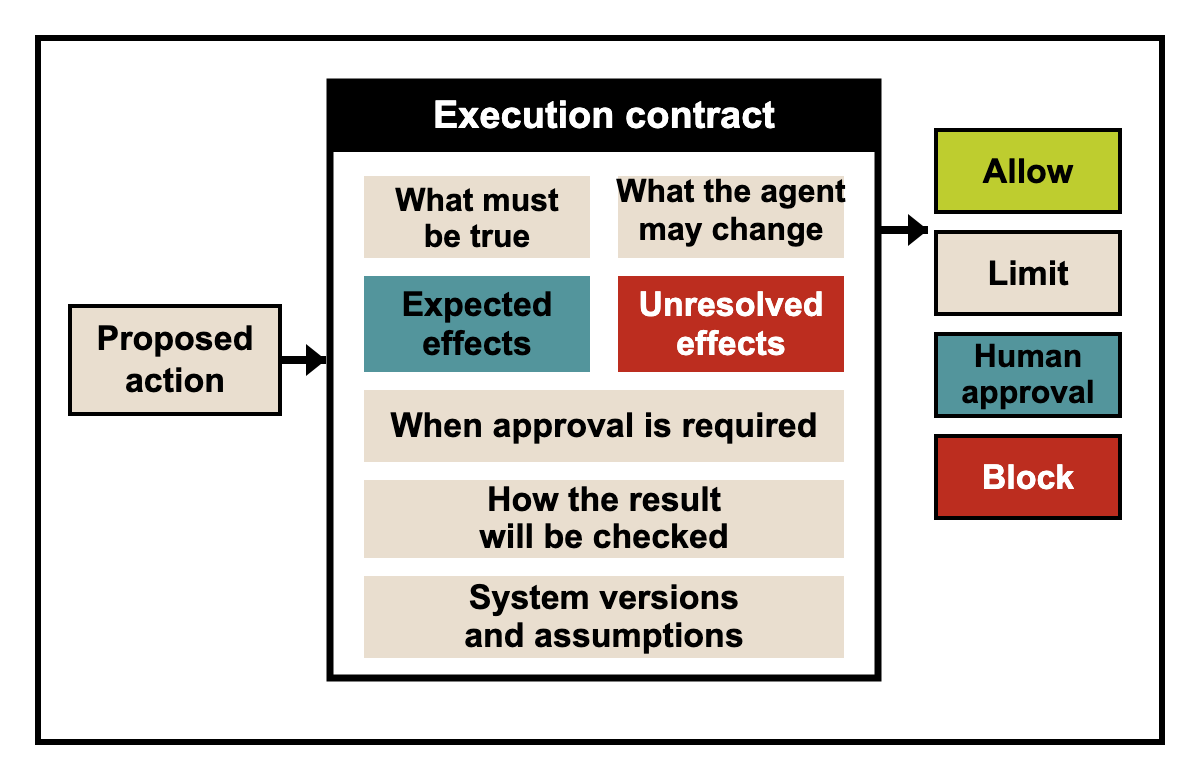
For important actions, I would bring this evidence into an execution contract with a version number. It covers one proposed action and should state:
- The action and what must be true before it runs.
- The permitted scope: which records, values, volume and time period the agent may affect.
- The expected effects supported by the available evidence.
- The unresolved effects that the organisation cannot yet confirm.
- The rules for allowing, limiting, escalating or denying the action.
- The checks and evidence needed to confirm what happened.
- The versions of automation, policies and integrations used to assess the action.
CrmWare combines these parts in a proposal, not an established standard. One proposed Salesforce architecture links risk to an action's effects and proposes scoring and approval, but was not tested in practice.10 Agent-First contributes preview and result checks.9 The execution contract adds wider business consequences, unresolved effects and the system setup used for assessment.
The organisation still needs evidence about the effects. Salesforce is useful because much of its automation can be inspected. One record update can trigger changes to related records, which Salesforce calls “dependency sprawl”.11 This helps identify expected effects.
Inspection may still miss part of the chain. A platform event can trigger business logic outside Salesforce.12 Salesforce's tools hide some external subscribers and omit some subscribers created by paused flows.13
When an effect cannot be confirmed, record it and attach a clear decision rule.
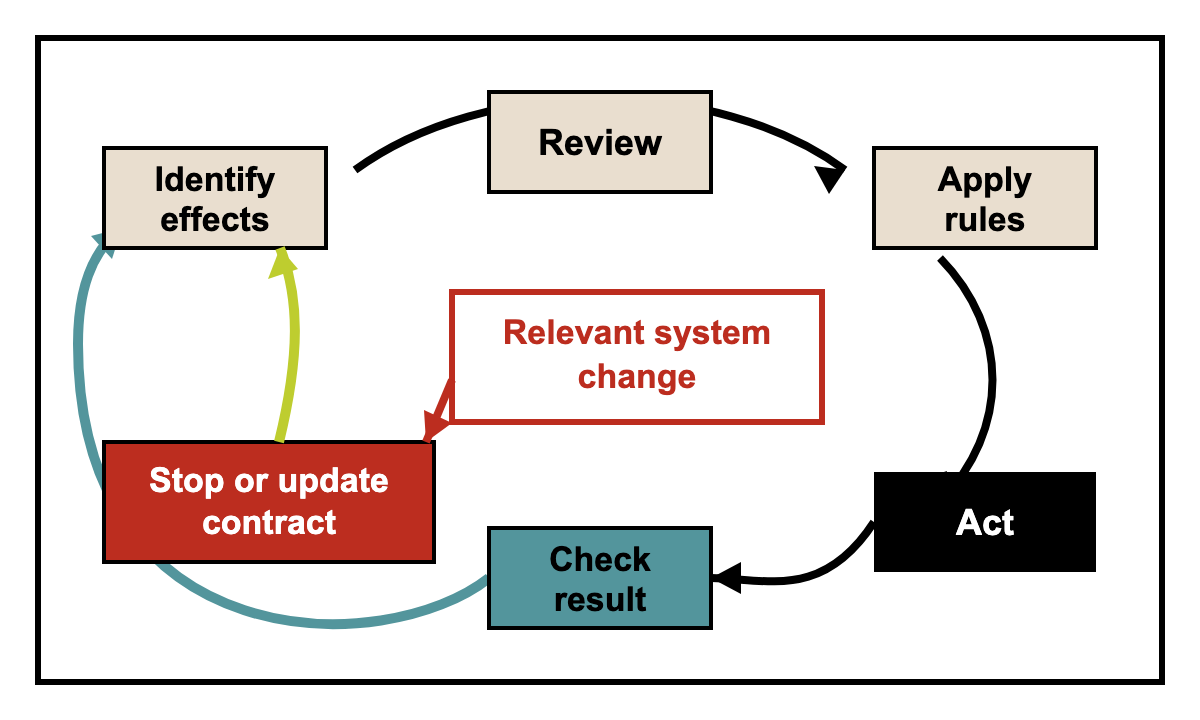
The contract is reliable only while the system remains unchanged. If relevant automation, policy or an integration changes, stop using the contract until it is updated.
Start with one action before scaling authority
A CIO does not need a complete map of every dependency. Start with one business action whose consequences you can trace, such as moving an opportunity to Closed Won.
Record the automation and policy versions you assessed. List expected and unresolved effects. Decide when the agent may proceed, when a person must approve and when to block the action. Define checks that do not rely on the agent's explanation.
Test the action in a controlled case and compare the records, events and external outcomes with the contract. Then change one relevant automation or policy and prove that the previous contract is rejected or regenerated.
This pilot can reuse current controls. Limits and transaction context can travel with the request.5, 6 A control can stop the proposal, while preview and verification compare what should change with what did change.7, 9 Rule-based authorisation remains separate from the agent's planning.3
The rules may be enforced in a gateway, policy engine, agent runtime, workflow or API layer. Choose the technology after defining the governance requirement.
If the organisation can do this for one action, the CIO has evidence to let agents handle more actions. If it cannot, wider write access would increase uncertainty along with capability.
References
1. OWASP Foundation. API6:2023 Unrestricted Access to Sensitive Business Flows. 2023. https://api-security.owasp.org/editions/2023/en/0xa6-unrestricted-access-to-sensitive-business-flows/
2. Salesforce Developers. Hosted MCP Servers General Best Practices. 2026. https://developer.salesforce.com/docs/platform/hosted-mcp-servers/guide/general-best-practices.html
3. International Monetary Fund. How Agentic AI Will Reshape Payments. 2026. https://www.imf.org/-/media/files/publications/imf-notes/2026/english/insea2026004.pdf
4. National Institute of Standards and Technology. Guide to Attribute Based Access Control (ABAC) Definition and Considerations, SP 800-162. 2019. https://csrc.nist.gov/pubs/sp/800/162/upd2/final
5. Internet Engineering Task Force. RFC 9396: OAuth 2.0 Rich Authorization Requests. 2023. https://www.rfc-editor.org/rfc/rfc9396.html
6. Internet Engineering Task Force. Transaction Tokens, draft-ietf-oauth-transaction-tokens-11. 2026. https://www.ietf.org/archive/id/draft-ietf-oauth-transaction-tokens-11.html
7. OWASP GenAI Security Project. Agent Control Standard v0.1.0. 2026. https://github.com/GenAI-Security-Project/agent-control-standard
8. arXiv. Before the Tool Call: Deterministic Pre-Action Authorization for Autonomous AI Agents. 2026. https://arxiv.org/abs/2603.20953v1
9. arXiv. Agent-First Tool API: A Semantic Interface Paradigm for Enterprise AI Agent Systems. 2026. https://arxiv.org/abs/2605.10555
10. International Journal of Artificial Intelligence and Machine Learning. Architecting Secure Enterprise AI Agents with Salesforce and Model Context Protocol (MCP). 2026. https://www.svedbergopen.com/index.php/ijaiml/article/download/2856/1798/6345
11. Salesforce Architects. Record-Triggered Automation. 2026. https://architect.salesforce.com/docs/architect/decision-guides/guide/record-triggered
12. Salesforce Developers. Enterprise Messaging Platform Events. 2026. https://developer.salesforce.com/docs/platform/platform-events/guide/platform-events-intro-emp.html
13. Salesforce Developers. Obtain a Platform Event's Subscribers. 2026. https://developer.salesforce.com/docs/platform/platform-events/guide/platform-events-get-subscribers.html