


What Does It Mean to Own Your Digital Workforce?

Exploring this for your team? Talk to CrmWare →
Our previous article ended on a question: your AI workforce will help run the business — who will control it? This one answers it with a definition you can test, not a sentiment. Owning a digital workforce is not owning the data your agents touch. It is holding the operational levers while agents do real work: the authority to suspend, audit, evaluate, and decide what version runs. Hold the levers and the workforce is yours. Hold only a contract, and you are renting.
Owning the data is not owning the agent
The comfortable answer is contractual: we own our data, the vendor signs an SLA, and someone reviews what the agents did each week. It is comfortable because every piece of it can be bought. It is also insufficient, and Europe has already run the experiment that proves it. Contracts said the data was theirs, yet the European Commission found customers "face a number of barriers" to leaving — egress charges, lengthy procedures, a lack of interoperability between providers — and had to legislate the switching mechanics in the Data Act.[1]
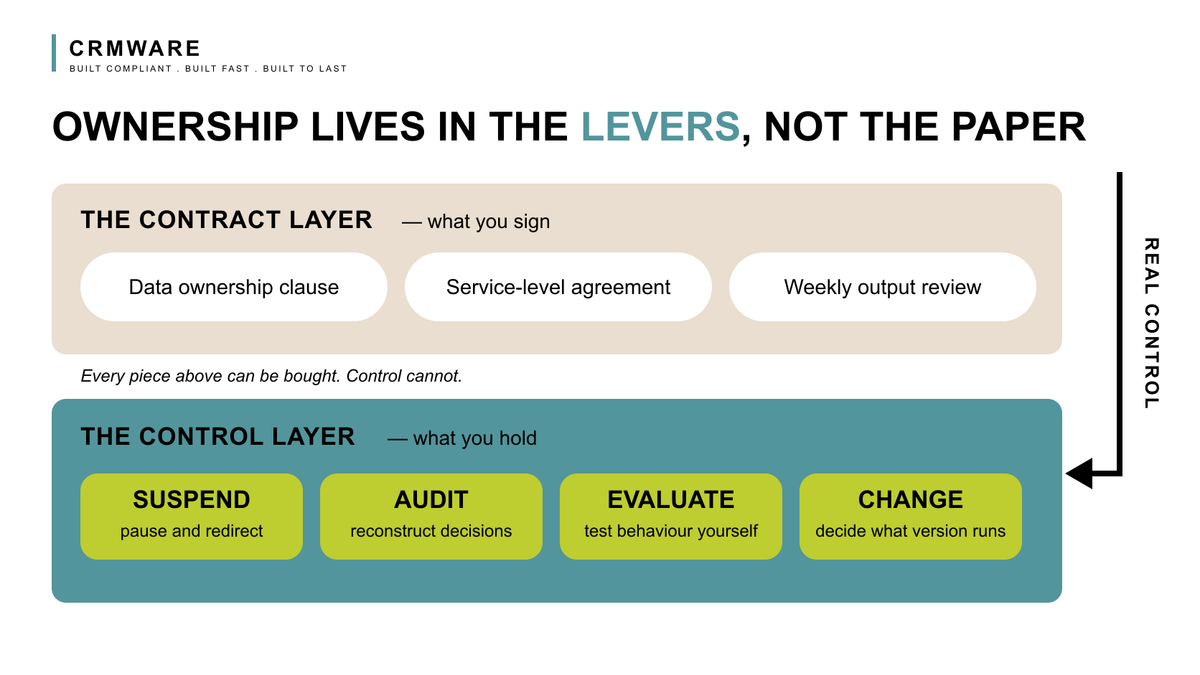
Financial regulators draw the same line on responsibility. The European Banking Authority is explicit that outsourcing "cannot result in the delegation of the management body's responsibilities": the institution remains fully responsible and accountable for the function, whoever operates it.[2] After-the-fact output review fails the same way — it tells you what your agents did, not whether you could have stopped them. You can outsource the work of a digital workforce. You cannot outsource owning it. So ownership has to be defined operationally — by the levers you hold, not the clauses you signed.
Four levers you either hold or you don't
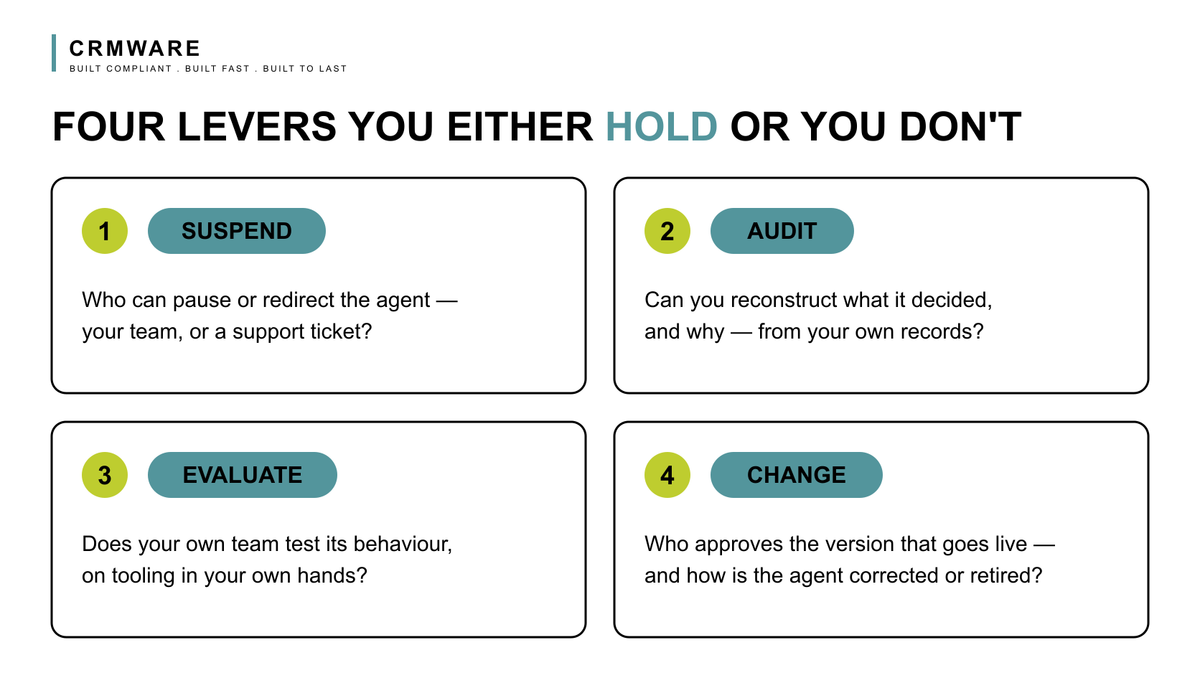
You own an agent when your organisation — not your vendor — holds four levers.
Suspend and redirect. The EU AI Act requires that oversight persons can "intervene in the operation" of a high-risk AI system or interrupt it "through a 'stop' button or a similar procedure", and can override or reverse its output.[3] NIST's AI Risk Management Framework asks for the same thing organisationally: mechanisms in place, with responsibilities assigned and understood, to supersede, disengage, or deactivate an AI system behaving inconsistently with its intended use.[4] The lever already exists in real platforms: in Agentforce, activating or deactivating an agent is a customer-side action gated by the Manage AI Agents permission (plus agent-type permissions) — permissions your organisation either holds or does not.[5]
Audit. Ownership means being able to reconstruct what an agent decided and why. In practice this is an entitlement to secure, not a default: Salesforce's audit trail for generative AI is available on specific editions with an add-on, with the data stored in Data 360.[6] If the audit lever is not in your agreement, it is not in your hands.
Evaluate. Evaluation tooling now ships in customer hands — Agentforce's Testing Center generates test scenarios and assesses response accuracy and action execution.[7] Who runs it is an organisational choice, not a platform constraint.
Change. Who decides which version of an agent runs? Only one version can be active at a time,[5] so version activation is a control point — and so are correction and retirement: NIST expects processes for decommissioning and phasing out AI systems safely.[4] Put the training question to your vendor as exactly that, a question: who retrains this agent, on what data, and who approves the new version before it goes live?
The test: remove the vendor from the loop
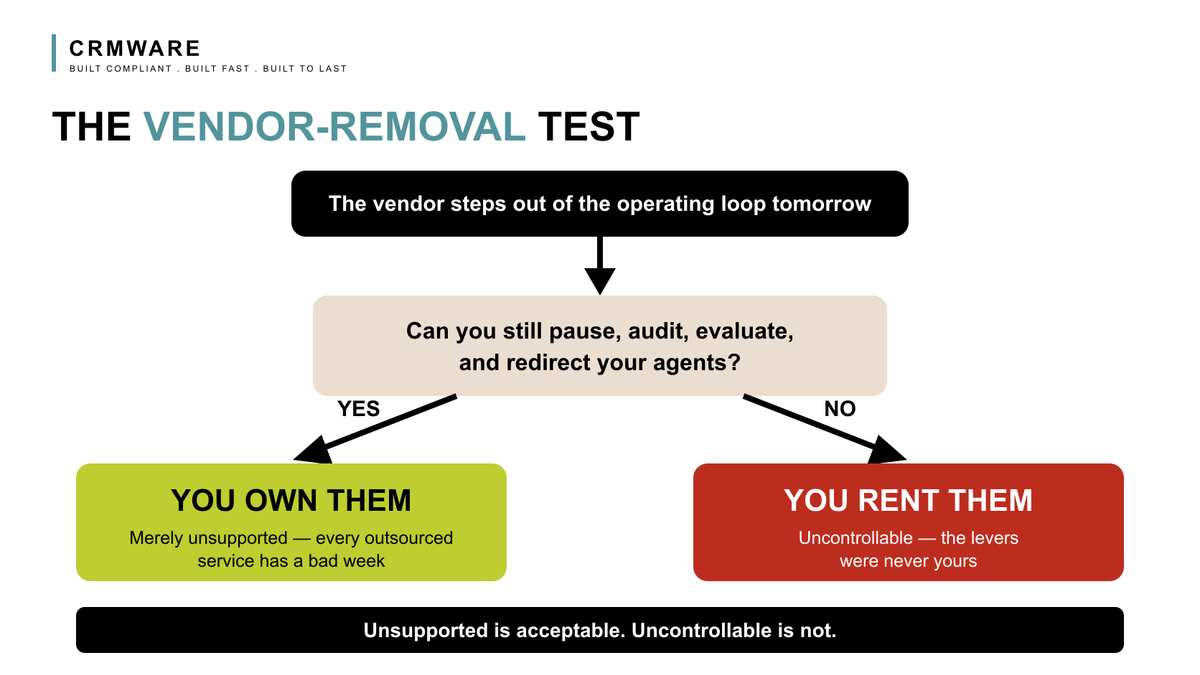
The definition is testable. Run the thought experiment: if the vendor stepped out of the operating loop tomorrow, could you still pause the agent, audit its decisions, evaluate its behaviour, and redirect it? Unsupported is acceptable — every outsourced service has a bad week. Uncontrollable is not. If vendor removal would make your agents uncontrollable rather than merely unsupported, you do not own them. You rent them.
This is a normative standard, and it is falsifiable: it would break on a counter-example — an organisation that plainly rents its agents, with the vendor holding all four levers, yet demonstrably controls the business outcomes those agents produce. We have not seen one. If you have, we want to hear about it.
Regulators already demand this stance: the EBA requires institutions to be able to exit outsourcing arrangements "without undue disruption to their business activities".[2] And the cost of failing the test is being priced in now. Gartner predicts over 40% of agentic AI projects will be cancelled by the end of 2027, with escalating costs, unclear business value, and inadequate risk controls as the stated causes — while "agent washing" inflates the field: Gartner estimates only about 130 of the thousands of agentic AI vendors are real.[8]
What to require before you sign
The definition earns its keep only if it changes what you do before signature. Each lever converts into one ask you can put in front of any vendor proposal this afternoon.
- Suspend: a named internal role holding the agent deactivation permission — a person with authority, not a support ticket with a response time.[5]
- Audit: the audit entitlement in the order form, priced and provisioned from day one, not a post-incident add-on you negotiate under pressure.[6]
- Evaluate: an evaluation runbook your own team operates, on tooling in your own hands, run before changes go live and on a schedule after.[7]
- Change: a version-and-exit plan in the agreement — who approves activation, how the agent is corrected, and how it is retired or moved without undue disruption.[4][2]
Our previous article asked who will control your AI workforce. The answer is now concrete: whoever holds these four levers — and that is decided at signature, not discovered in production. This is what it means to own the capability instead of renting the dependency.
References
[1] European Commission. Data Act explained. 2024. https://digital-strategy.ec.europa.eu/en/factpages/data-act-explained
[2] European Banking Authority. Guidelines on outsourcing arrangements (EBA/GL/2019/02). 2019. https://www.eba.europa.eu/sites/default/files/documents/10180/2551996/38c80601-f5d7-4855-8ba3-702423665479/EBA%20revised%20Guidelines%20on%20outsourcing%20arrangements.pdf
[3] European Commission. AI Act Service Desk — Article 14: Human oversight. 2024. https://ai-act-service-desk.ec.europa.eu/en/ai-act/article-14
[4] NIST. AI Risk Management Framework 1.0 — Core (AI Resource Center). 2023. https://airc.nist.gov/airmf-resources/airmf/5-sec-core/
[5] Salesforce. Activate or Deactivate Your Agent (Agentforce documentation). 2026. https://help.salesforce.com/s/articleView?id=ai.copilot_setup_activate_deactivate.htm&language=en_US&type=5
[6] Salesforce. Audit Trail (Einstein Generative AI documentation). 2026. https://help.salesforce.com/s/articleView?id=ai.generative_ai_audit_trail.htm&language=en_US&type=5
[7] Salesforce. Agentforce Testing Center (documentation). 2026. https://help.salesforce.com/s/articleView?id=ai.agent_testing_center.htm&language=en_US&type=5
[8] Gartner. Gartner Predicts Over 40% of Agentic AI Projects Will Be Canceled by End of 2027. 2025. https://www.gartner.com/en/newsroom/press-releases/2025-06-25-gartner-predicts-over-40-percent-of-agentic-ai-projects-will-be-canceled-by-end-of-2027